
Closed vs Open Trades: Which Ones Count When You Judge a Strategy?
Open trades matter, but they are not finished outcomes. Learn how to keep them visible without letting unrealized results distort your strategy statistics.

An open trade can be profitable at noon and negative by the close. A losing position can recover before its planned exit, while a winning one can reverse. Until the strategy's exit rule has been reached, the result is still changing.
That leads to a simple but important rule for reviewing a trading strategy:
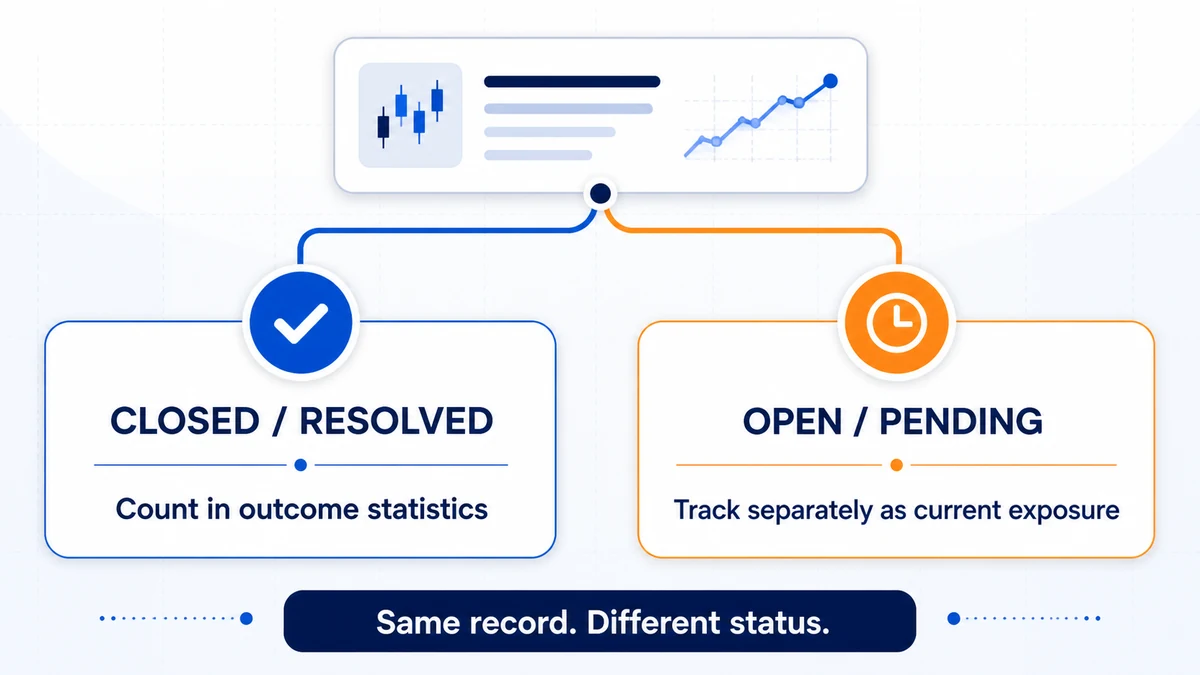
Use closed trades to calculate outcome statistics. Keep open trades visible as a separate measure of current exposure and unresolved results.
This is not an argument for hiding open positions. It is the opposite. A useful record shows both groups clearly, but it does not pretend they answer the same question.
Closed and open trades answer different questions
A closed trade has an entry and a completed exit. Its result can be classified using the rules you defined in advance: win, loss, breakeven, or another explicit outcome category.
An open trade has an entry but no completed exit. Its current profit or loss is unrealized. That value can help you understand exposure, risk and what remains unresolved, but it is not yet the strategy's final outcome.
| Status | What it tells you | Where it belongs |
|---|---|---|
| Closed / resolved | What happened after the full rule set played out | Win rate, average win, average loss and other outcome statistics |
| Open / pending | What is still active and exposed to market movement | Open-trade count, unrealized P&L, age, current risk and pending workload |
| Canceled / unfilled order | No position was opened | Execution or signal log, not trade-outcome statistics |
Trading platforms commonly preserve this separation. TradingView, for example, defines realized P&L through closed positions and unrealized P&L through active positions. Its “total winners” metric also excludes currently open positions. These are platform definitions, not universal scientific laws, but they illustrate the clean denominator needed for a result statistic.
The denominator is the real issue
Win rate is usually calculated as winning closed trades divided by closed trades that qualify under your predefined classification rules. If open trades enter the denominator before their outcomes are known, the percentage stops answering a stable question.
Consider a record with:
- 10 closed trades: 6 wins and 4 losses
- 3 open trades: 2 currently positive and 1 currently negative
The resolved win rate is 60%: 6 wins out of 10 closed outcomes.
If you count all 13 trades but refuse to classify the open ones, the displayed rate falls to about 46%. If you temporarily call the two positive open trades “wins,” it rises to about 62%. Neither alternative is a stable description of the strategy because tomorrow's price can change all three open results.
The record should instead show two lines:
- Resolved outcomes: 6 wins, 4 losses; win rate 60%
- Open exposure: 3 active trades; 2 currently positive, 1 currently negative
Nothing is hidden, and nothing unfinished is promoted into a final result.
Why unrealized P&L is not a final outcome
Unrealized P&L is useful. It can show current account exposure, the amount at risk, and whether several positions are moving together. It can also be part of an equity curve or a mark-to-market portfolio view.
But an equity snapshot and a completed-trade statistic answer different questions:
- Equity or total portfolio value: What is the account worth at this moment, including open positions?
- Closed-trade analysis: What happened when the strategy's entry and exit rules completed?
A method can legitimately use both. The mistake is combining them without naming the measurement. If you report a total return that includes mark-to-market values, say so and fix the valuation time. If you report win rate by trade, use completed outcomes and state how breakeven and partial exits are handled.
The dangerous version: winners closed, losers left open
The clean separation becomes especially important when losing positions remain open longer than winners. A record can look impressive if profitable trades are closed and counted while losing trades sit outside the statistics indefinitely.
Research on the disposition effect has documented a tendency among many investors to realize gains more readily than losses. Terrance Odean's study of 10,000 brokerage accounts is a classic example. That evidence does not prove that every open losing trade reflects bias: a position may still be open because its predefined time horizon or exit condition has not been reached. It does show why an unresolved losing position should remain visible rather than disappear from the review.
Three checks help:
- Was the exit rule written before entry?
- Is the position still within that rule and its intended time horizon?
- Are overdue or rule-breaching positions flagged separately?
The number of open trades alone does not prove that an exit method is poor. A weekly strategy will naturally keep positions open longer than an intraday strategy. The useful comparison is against the strategy's own documented horizon and rules.
Define the unit before you calculate anything
“One trade” is not always as obvious as it sounds. A platform may treat a trade as an entry paired with an exit, while a trader may scale into one position with several orders or close it in stages. If the unit changes from case to case, the statistics become difficult to interpret.
Choose a consistent rule before reviewing the record. For example:
- One strategy case remains open until the entire planned position is closed.
- A partial exit updates the case, but does not create a second independent win.
- Separate entries are separate cases only when the strategy definition says they are.
- Fees and slippage are recorded consistently when the final outcome is calculated.
There is no single convention that fits every strategy. Consistency is the important part. Write the convention down, apply it to every case, and create a new strategy version if the rule changes materially.
Edge cases that need an explicit rule
Breakeven trades
Decide whether breakeven is a third category or excluded from the win/loss percentage. Do not switch treatment after seeing the result. Report the count separately so another reader can reconstruct the denominator.
Partial closes
If part of a position is closed while the rest remains open, the realized portion and remaining exposure both matter. For strategy-level case analysis, a practical approach is to keep the case pending until the predefined exit process is complete, while recording the realized partial result inside it. Whatever approach you choose must be consistent.
Time-based exits
A trade can be resolved because a time limit expired, even if neither a target nor a stop was reached. “Resolved” means the documented exit rule completed; it does not mean the trade was profitable.
Manual exits and rule violations
Record the financial outcome and the rule-compliance status separately. A profitable manual exit is still a profitable outcome, but it may not be valid evidence for the unchanged strategy if the exit contradicted its rules.
Open trades at a review cutoff
When comparing monthly or quarterly snapshots, freeze the review date. Show open positions and their unrealized values as of that date, but do not retrospectively insert their later outcomes into the old snapshot. Add those outcomes to the period or cohort defined by your review method.
A practical review structure
A clear strategy review can be organized in five steps.
1. Freeze the strategy definition
Record the entry rule, exit rule, timeframe, sizing convention and what counts as one case. Changing a rule creates a new version; otherwise old and new outcomes are mixed.
2. Assign one status to every case
Use simple states such as pending, resolved-win, resolved-loss, resolved-breakeven and invalid. Avoid vague labels that let a result move between categories after the fact.
3. Calculate outcome metrics from resolved cases
Use the same resolved denominator for win rate and related trade-outcome statistics. Show the resolved count beside every percentage so a small sample cannot look more certain than it is.
4. Report pending exposure separately
Show the number of open cases, their age, unrealized P&L if relevant, and whether they remain within the predefined rules. This prevents pending losses from becoming invisible.
5. Reconcile the record
Every entered case should be traceable. The resolved count plus the pending count plus any explicitly invalid cases should reconcile to the total record. A missing case is a data-quality problem, not a neutral omission.
How Stick Stock applies the separation
Stick Stock is designed around the distinction between resolved and pending cases. The resolved group supports comparison of completed outcomes, while pending cases remain visible as work that has not reached a final status.
That separation does not tell you whether a strategy is good, and it does not predict the outcome of an open trade. It makes the record easier to audit and reduces the chance that an unfinished position silently changes the story told by the statistics.
The takeaway
Closed and open trades both belong in a complete strategy record, but they do not belong in the same outcome denominator.
Use closed trades for statistics that require a final result. Track open trades separately for exposure, unrealized P&L, age and rule compliance. Define edge cases before reviewing the numbers, and keep the total record reconcilable.
The goal is not to make the strategy look better or worse. It is to make the result mean what its label says.
Educational note: This article explains a documentation method for reviewing strategy records. It is not investment advice or a recommendation to buy, sell or hold any security.
FAQ
Do open trades count in win rate?
No. A win rate needs completed outcomes, so open trades should not be classified as wins or losses before the exit rule is complete. Keep their count and unrealized P&L visible separately.
Should unrealized losses be included when judging a strategy?
They should be visible, but not treated as final losses unless the predefined exit rule has resolved the trade. Track them as current exposure and review their age and rule compliance.
What if a trade is partially closed?
Define one consistent case rule. A practical method is to record the realized partial result while keeping the case pending until the planned exit process is complete. Do not count each partial fill as an independent win unless the strategy definition explicitly does so.
Can I include open positions in an equity curve?
Yes. An equity or mark-to-market view can include current values of open positions. Label it clearly and do not confuse that portfolio snapshot with closed-trade win rate.
Does a large number of open trades mean my exit rules are bad?
Not by itself. The expected number and age of open trades depend on the strategy's timeframe and exit conditions. Compare them with the documented rules and flag cases that exceed those rules.
References
- TradingView — Total winnerstradingview.com · accessed 2026-08-06
- TradingView — What is the account managertradingview.com · accessed 2026-08-06
- TradingView — List Of Trades Tabtradingview.com · accessed 2026-08-06
- Terrance Odean, UC Berkeley — Are Investors Reluctant to Realize Their Losses?faculty.haas.berkeley.edu · accessed 2026-08-06
DisclosureFor informational purposes only. Stick Stock gives no buy or sell recommendations and executes no trades.